Why Do We Want to Look Younger?: The Psychology Behind the 'Baby Face' Obsession
We don't just age—we ripen. What does our obsession with looking young reveal about ourselves?

The Stranger in the Mirror: Why We Crave Looking Younger
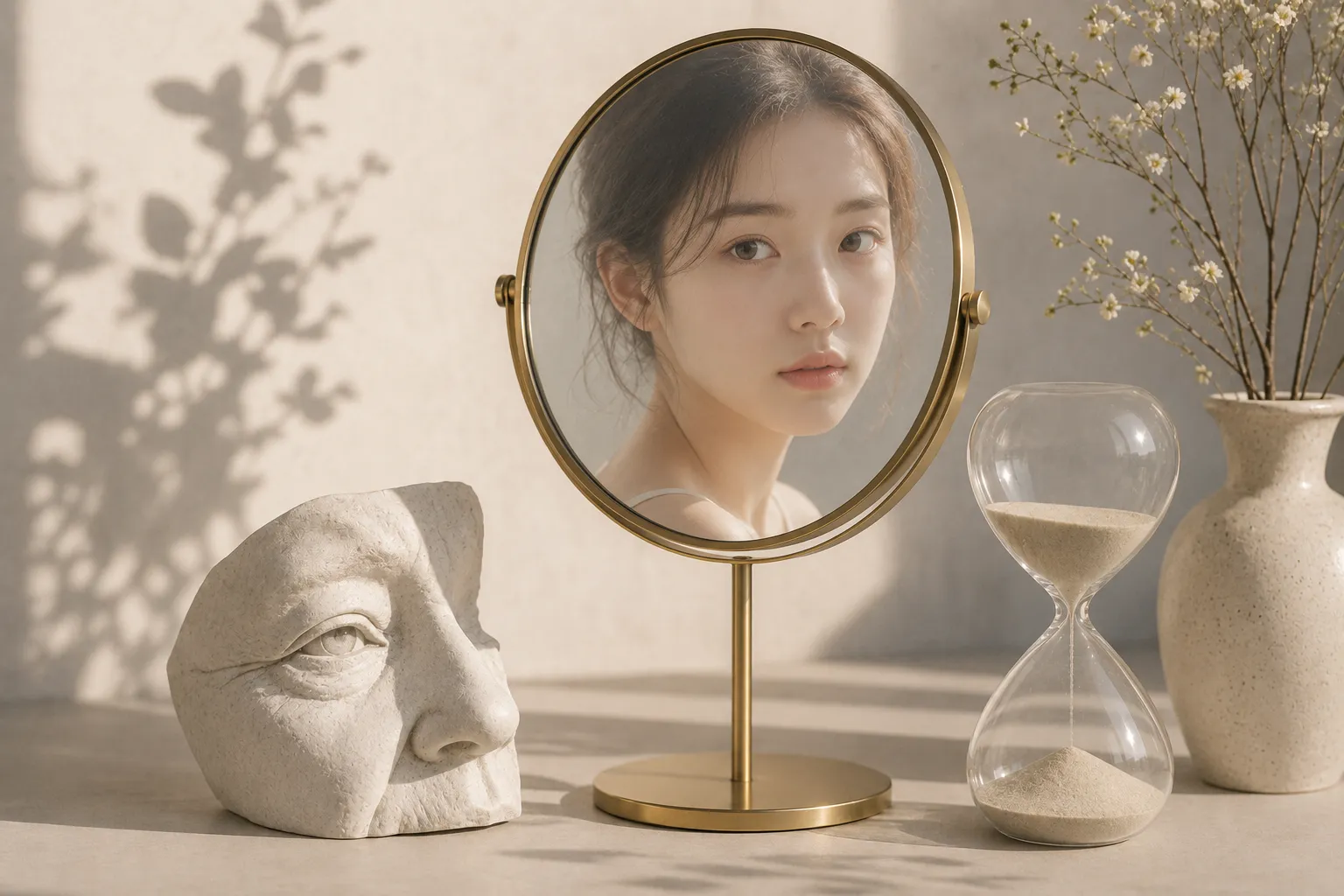
"You can't possibly have a child that old!" or "You look so much younger in person!" Have you ever received these comments and taken them purely as compliments? Chances are, you've also felt that tiny internal flinch when someone implied you looked your age—or worse, older. In our society, the word "youthful" has become something of a magic spell, and for good reason: it touches on far more than just appearance. It taps into a complex web of psychological needs we carry within us.
When we stand before the mirror, what exactly are we hoping to see? In a rapidly changing world, youth has become synonymous with vitality, energy, and opportunity. This connection runs especially deep in societies where appearance functions as a form of social currency. Maintaining a youthful image satisfies social expectations while simultaneously feeding our desire to feel attractive and capable.
It's a peculiar irony: as children, we can't wait to grow up, yet once we do, we find ourselves longing for the youth we left behind. This isn't merely about chasing physical appearance—it connects to something deeper. We're often trying to recapture the energy, the sense of possibility, or the validation we once enjoyed. Psychology frames this as an attempt to bridge the gap between our "Ideal Self" and our "Actual Self"—the natural human desire to close the distance between who we want to be and who we currently are.
But when the pursuit of looking younger becomes an obsession, it can transform from aspiration into anxiety. Trying to conform to society's narrow standards of beauty makes it increasingly difficult to accept and love ourselves as we are. The cult of youth, intertwined with our broader fixation on appearance, delivers both benefits and burdens.
So why are we so drawn to looking younger? Here are some possible explanations:
| Reasons for Wanting to Look Younger | Explanation |
|---|---|
| Desire for Social Approval | In a culture that rewards youthful, vibrant appearances, looking younger can feel like a shortcut to confidence and positive regard. |
| Positive Self-Image | We believe that a younger appearance will make us feel more attractive and energetic. |
| Access to Opportunities | In a world that equates youth with potential, looking younger seems like a gateway to more possibilities. |
| Nostalgia for the Past | Sometimes the desire to look young reflects a longing for the energy and positive experiences of earlier years. |
What about you? Is there a particular reason the idea of looking younger resonates so strongly with you?
Sources and References:
- Social Identity Theory: This framework suggests that we derive self-esteem and understanding from the groups we belong to. When society values youth, that valuation inevitably shapes how individuals see themselves.
- Self-Determination Theory: According to this theory, humans have core psychological needs for competence, autonomy, and relatedness. The pursuit of a youthful appearance can be understood as one way of meeting these needs—particularly the desire for competence and positive social connections.
Is the Obsession with Youth a Wave We're Riding—or Drowning In?
When we think about looking young today, we're not just talking about smooth skin or the absence of wrinkles. The concept carries an entire fantasy: vitality, energy, radiance—and perhaps the unspoken promise of never really growing old at all. But here's a question worth asking: Does this desire spring from somewhere deep within us, or have we simply been swept up in a cultural current we didn't choose?
People have always valued youth to some degree. But has it ever been quite so absolute—so all-consuming—as it is today? Modern society, amplified by media's relentless glow, has created an image-obsessed culture. Television, magazines, and now social media flood us with young, beautiful faces. These images often present an airbrushed perfection, implying that youth is the only path to success and happiness.
Within this current, aging and natural physical change have come to feel like problems to solve—flaws to hide. It's fascinating to look back at how different cultures throughout history have defined beauty in vastly different ways. At various times, fuller figures or pale complexions were the height of desirability. But as Western cultural influence expanded in the modern era, slim and youthful became the global aesthetic ideal. And over time, that ideal has only sharpened its focus on youth itself.
Time passes for everyone equally—so why do we keep trying to reverse its course? I believe the answer lies in the particular values of our modern world. In societies that prize productivity and efficiency above all else, youth becomes shorthand for fresh ideas, boundless energy, and adaptability. Against this backdrop, aging can feel like falling behind in a competition we never agreed to enter.
Media compounds this pressure by presenting youth as an achievable goal rather than a temporary state. We're sold the fantasy of eternal youth, and with it comes an implicit message: if you're not young-looking, you're somehow lacking. It's not unlike the trap of perfectionism—the relentless pursuit of an impossible standard that ends up making self-acceptance harder, not easier.
What societal and psychological forces drive our fascination with looking young? Consider these dynamics:
| Sociocultural Factors | Personal Psychological Factors | Impact on Youth Preference |
|---|---|---|
| Media's Celebration of Youth | High Need for Social Approval | We seek confidence through appearances that society rewards with positive attention. |
| Productivity-Centered Culture | Success-Oriented Mindset | When youth equals capability and opportunity, looking younger feels like maintaining competitive edge. |
| Narrow Beauty Standards | Fear of Diminished Self-Worth | Anxiety about losing attractiveness or value with age drives attempts to preserve a youthful appearance. |
| Unrealistic Beauty Ideals | Nostalgia for the Past | The desire to look young can connect to longing for the energy and positive experiences of earlier years. |
When you hear someone described as "young-looking," what's your first reaction? Have you ever wondered whether society's expectations might be shaping your preferences more than you realize?
Sources and References:
- Cultural Criticism Theory: This approach examines how mass media shapes values and desires through repeated exposure to certain images and narratives.
- Michel Foucault's Discipline and Punish: Foucault's philosophical exploration of how social norms and power structures influence individual bodies and behaviors offers insight into how beauty standards become internalized.
Unpacking the Psychology Behind Our Desire to Look Younger
The fascination with youthful appearance extends far beyond surface-level vanity. It connects to complex needs rooted deep in our psyche. Perhaps we're not really trying to turn back time—we're projecting our desire to gain more from the present moment. We'd rather frame aging as "maturation" and "refinement" than as decline.
One powerful driver is the need for recognition and approval. Society tends to link youth with attractiveness, competence, and positive energy. Maintaining a youthful appearance, then, becomes a way of signaling these qualities to others—an unconscious strategy for making favorable impressions and accessing opportunities. It reflects a belief that our outer appearance serves as a window into our inner worth.
Another factor is anxiety management. As we age, physical changes and shifting social roles can trigger uncertainty. Looking young becomes a way of maintaining a sense of control—a psychological anchor in the face of inevitable change. By preserving or reclaiming a youthful image, we might be trying to quiet our fears about the future or hold onto hope.
The pursuit of youth also intertwines with ideas about success. In a fast-paced, competitive environment, youth signifies trend-awareness, technological fluency, and energetic output. Looking young can feel like proof that we're still relevant, still in the game. It's as if youth were the fuel we need to reach our destinations.
Ultimately, our desire to look younger reflects more than a wish to be attractive. It encompasses our needs for recognition, security, and achievement. Perhaps what we really need is a new perspective—one that views aging not as loss, but as the accumulation of wisdom and experience.
What psychological needs might be driving your own relationship with youth and appearance?
| Core Need | Connection to Looking Younger | Underlying Psychology |
|---|---|---|
| Recognition | Youthful, vibrant appearance = positive evaluation | We want others to see us as attractive and capable. |
| Security | Familiar younger image = sense of control | We seek to reduce anxiety about aging and feel stable in the present. |
| Achievement | Youth = opportunity and competitiveness | We want to leverage youthful image for social and professional success. |
| Self-Efficacy | Maintaining appearance = control over our lives | Managing our looks provides a sense of accomplishment and confidence. |
Which of these needs resonates most with you? Do you sometimes feel that looking younger is the key to becoming a better version of yourself?
Sources and References:
- Self-Determination Theory: This psychological framework suggests that people thrive when their needs for competence, autonomy, and relatedness are met. Pursuing a youthful appearance may represent one strategy for fulfilling these needs.
- Social Learning Theory: This theory explains how people learn by observing others. We may learn to value youth by watching media portrayals that associate it with positive outcomes.
Your Relationship with Aging: A Self-Reflection Checklist
Have you ever felt a pang of worry standing before the mirror, wondering if you look older than you'd like? Or found yourself devoting considerable time and energy to maintaining a youthful appearance? You're not alone. In today's world, attention to appearance—especially looking young—is entirely normal. But sometimes this focus can become a source of stress rather than satisfaction.
This section offers a gentle self-reflection checklist to help you examine your current relationship with the idea of looking young. Use it as an opportunity to understand yourself better and consider what it might mean to embrace a more balanced perspective. Moving beyond appearance-obsession toward genuine self-acceptance is possible—and it starts with honest reflection.
Read each question and consider which response feels closest to your experience. The key is honesty with yourself.
How Much Does Looking Young Concern Me? (Self-Reflection)
| Question | Rarely (A) | Sometimes (B) | Often (C) | Always (D) |
|---|---|---|---|---|
| 1. I feel anxious at social gatherings if I don't think I look the youngest in the group. | ||||
| 2. When I see ageless celebrities on social media, I find myself thinking, "I want to look like that." | ||||
| 3. I consider investing significant time and money in skincare completely justified. | ||||
| 4. Sometimes I avoid meeting new people because I worry about looking older than I'd like. | ||||
| 5. I frequently feel anxious that aging means falling behind in society. | ||||
| 6. I sometimes think that without a youthful appearance, I'll be less attractive or harder to love. | ||||
| 7. When updating my makeup or fashion, "looking younger" is my primary consideration. | ||||
| 8. I struggle to accept the physical signs of aging—wrinkles, gray hair, and the like. |
This checklist is simply a tool for gentle self-examination—not a judgment. If some of your responses give you pause, there's no need for self-criticism. What matters is the willingness to look inward and ask yourself, "Why do I feel this way?"
Sources and References:
- Self-Concept Theory: Our beliefs about ourselves influence our behavior. When our self-image around appearance feels negative, it can affect our self-esteem and actions.
- Social Comparison Theory: We often evaluate ourselves by comparing ourselves to others. This framework helps explain the emotions that arise when we measure ourselves against youthful celebrities or peers.
Did this checklist help you understand your feelings about looking young? What does "youth" as a value mean to you?
Embracing the Beauty of Right Now
If the self-reflection above revealed something about your relationship with youth and aging, take a moment to offer yourself some grace. Try saying this: "It's okay—I'm beautiful exactly as I am right now." Aging isn't decline or ending. It's more like a fruit ripening—deepening in flavor, enriched by time and experience. Rather than exhausting yourself trying to fit into a narrow ideal of youth, consider focusing on cultivating the unique beauty that comes with your particular journey.
Healthy eating, regular exercise, and above all, a positive mindset—these do more for your wellbeing than any external standard ever could. The depth and maturity that come with age create an allure that no amount of youthful energy can replicate. You, as you are right now, are already beautiful.
Healthy Habits for Nurturing Your Authentic Self
| Healthy Habit | My Plan | Expected Benefits |
|---|---|---|
| Regular Exercise (e.g., 30-minute walks three times weekly, yoga) | Stress relief, increased vitality, physical health maintenance | |
| Balanced Nutrition (e.g., seasonal vegetables, adequate protein) | Improved skin health, stronger immunity, sustained energy | |
| Adequate Sleep (e.g., seven or more hours nightly) | Recovery from fatigue, mental stability, sharper focus | |
| Mindfulness/Meditation (e.g., ten quiet minutes daily) | Reduced stress, better emotional regulation, inner peace | |
| Hobbies/Learning (e.g., new skills, reading) | Sense of accomplishment, joy, cognitive health, life satisfaction |
These habits shift focus from the external goal of "looking young" to the internal goal of "being healthy and happy." In the process, your authentic appeal naturally shines through.
Sources and References:
- Positive Psychology: This field focuses on human strengths and potential, studying ways to enhance happiness and life satisfaction. A positive perspective on aging plays a significant role in overall wellbeing.
- Health Behavior Theory: This theory explains how people adopt and maintain health-promoting behaviors, showing that consistent healthy habits improve quality of life across all dimensions.
What if you viewed aging as a blessing? How might you let your unique beauty shine even brighter?
* Look forward to more stories that add meaning and fulfillment to your life.
* Your warmth and encouragement mean more than you know.