Tips for More Accurate Face Similarity Results
Why does the similarity score change between photos? Here's how to get the most consistent and accurate results when comparing two faces.

Why Does the Score Change Between Photos?
"The sync rate was different yesterday!" This is completely normal. AI extracts facial features from the visual information in your photos — change the conditions, and different features get emphasized, shifting your score.
Both photos matter equally. Even if one photo is perfect, a blurry or poorly angled second photo will reduce accuracy.
Best Photo Conditions
Framing
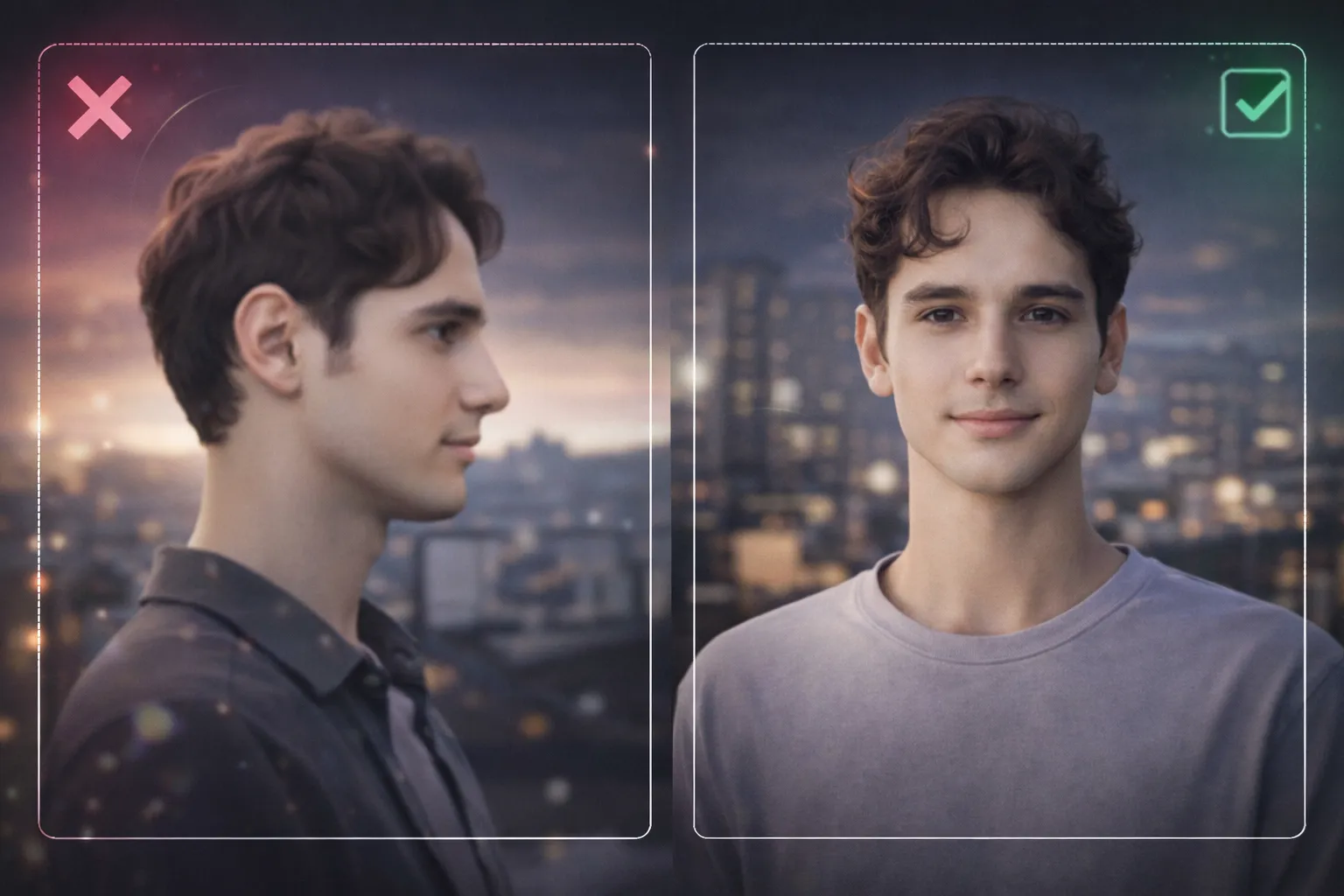
Good framing:
- Face pointing straight at the camera
- Face fills roughly 50–70% of the frame
- Full face visible from forehead to chin — no cropping
Avoid:
- Profile shots: the AI can't analyze the full face
- Extreme downward angle
- Face too small in a full-body shot
Lighting
| Lighting | Effect on Results |
|---|---|
| Natural front light | Balanced feature reveal — most accurate |
| Side lighting | Emphasizes one side; may distort features |
| Backlight | Face becomes silhouette; extraction fails |
| Dark indoors | Increased noise; accuracy drops |
| Strong flash | Flattens the face; loses depth cues |
Expression and Eyes
- Eyes wide open, relaxed expression is optimal
- Squinting disrupts eye-shape analysis
- Wide-open mouth changes lower-face proportions
Hair and Accessories
- Forehead visible is better — forehead area influences face-shape analysis
- Bangs covering the eyes disrupt landmark detection
- Always remove sunglasses — covered eyes severely degrade accuracy
- Remove large earrings, hats, and masks
Tips for Celebrity Comparisons
Want to compare your face with a celebrity? The celebrity photo matters too.
Good celebrity photos:
- Official portraits or interview shots (front-facing, natural lighting)
- Unretouched or lightly retouched photos
- Everyday looks without heavy stage makeup
Avoid:
- Strong stage lighting (distorts color and depth)
- Heavily retouched magazine covers
- Photos with masks or heavy costume makeup
Skip the Filters
Beauty filters and retouching apps distort the facial data AI uses:
- Eye-enlarging → changes actual eye spacing
- Face-slimming → creates a face shape you don't have
- Nose reshaping → alters actual nose proportions
For the most genuine comparison, use unfiltered photos for both people.
Test Multiple Times for the Best Answer
Don't put too much weight on a single result. Test 3+ times with different photos of both people, and look for the consistently recurring percentage — that's the most reliable indicator of actual facial similarity.