
Finding Opportunity in a Sinking Startup
The final decision of an executive on a crumbling ship, and the thirst for "real skills."

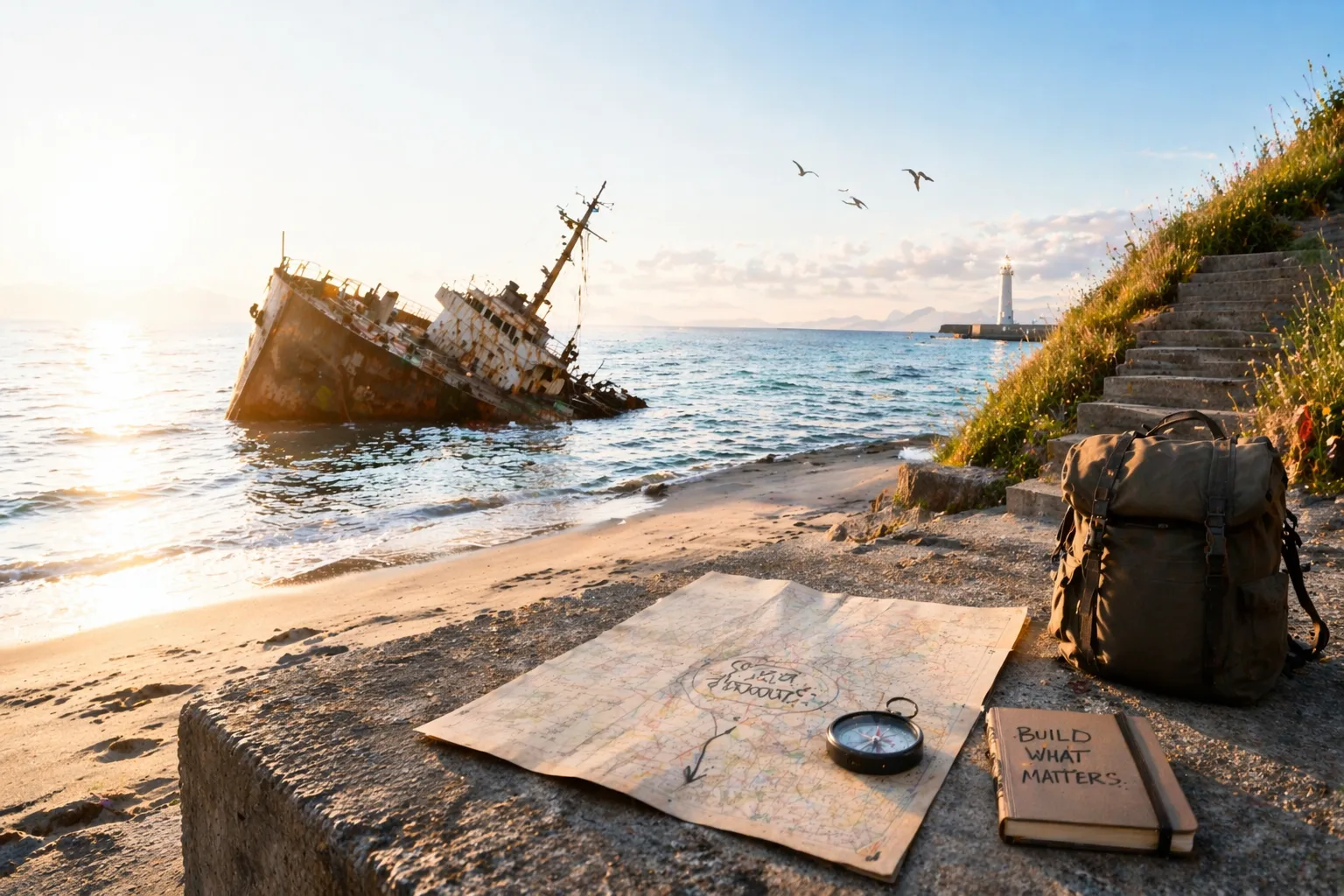
When the Ship Started to Tilt
When I left a top-tier strategy consulting firm to join a startup as an executive, my heart was full of conviction that I could change the world. As a consultant who had proposed "perfect strategies" to countless companies, I finally had a stage to prove my own equations for success. However, the reality of a startup was far colder than any flashy PPT slide.
Not long after joining, the atmosphere of the company began to shift. A heavy silence hung in the conference rooms, metrics plummeted, and capital dried up rapidly. As the ship began to tilt, people started packing their bags one by one. As a strategist, the first emotions I felt were embarrassment and helplessness. There were massive omens of collapse unfolding before my eyes that could not be solved by "willpower" alone. I was frustrated, then angry, and finally, fearful. "I just changed jobs—do I already have to look for another option?" This question haunted me every night.
The "Manual of What Not to Do" Revealed
While most people were busy looking for an exit, I strangely began to notice the unique data points this situation provided. The "essence of the system," which is never visible when an organization is running well, was revealed in its rawest form as the ship began to crumble.
In a healthy organization, even if a problem arises, someone is silently blocking it, or the momentum of the system makes it seem as though things are functioning. But as resources vanished and people left, the weakest links in the organization and the reasons for recurring inefficiencies became transparent.
I decided to observe this process of collapse thoroughly rather than just enduring it. I had designed innovation plans for numerous companies during my consulting days, but witnessing how an organization actually falls apart on the front lines was a completely different level of education. What I learned during that time was not a specific skill or knowledge:
- How responsibility evaporates when decision-making is opaque.
- How politics overwhelms practical work in an organization that has lost its vision.
- How expansion without standards eats away at the foundational strength of an organization.
If the success stories of unicorn companies are "Answer Keys," the scene of a failing startup was a "Manual of What Not to Do." And I realized painfully that in the real world, the ability to avoid wrong answers determines survival more than getting the right ones.
The Most Painful Decision as an Executive
Observation was one thing, but my responsibility as an executive was another. My final task was to reduce the weight of the sinking ship and keep the voyage going as long as possible. I opened the books and began the most painful work. I had to lead the restructuring process, keeping only the essential personnel necessary for survival. Thinking about the future of the junior employees kept me awake at night with guilt, but as an executive, it was my duty to extend the life of the company by even a single day.
After completing the reorganization, I looked at myself. Coldly calculating the numbers, the biggest "cost" at the time was myself—an executive with a high salary. I was skilled in strategy, but I lacked the practical ability to repair services or write code to keep the product running.
"Does my presence here help the company survive?"
The answer was clear. My salary could buy several months of precious time for multiple developers who could do the actual work. At a time when technology-centered survival was desperate, an executive who only devised strategies was perhaps the heaviest burden to be shed first. Thinking only of the company's survival, I ultimately put my own name on the resignation list. The judgment that the company could go further only if I stepped down—that was my final strategic decision.
The Helplessness of a Strategist Without Practical Skills
Even after deciding to leave, I didn't pack my bags immediately. I communicated with investors to explain the situation and coordinated the management structure of the final project so that the remaining developers wouldn't lose their way. Although I was leaving, I had to ensure that the minimum survival system I designed was functioning properly.
The helplessness I felt during this process completely changed the direction of my life. The question "Why can't I build this myself?" never left my mind. As a strategy consultant and executive, I had designed countless business logics, but having no hands to actually implement them was like fighting in the wilderness without a weapon. It was the moment I felt the limits of a business mindset not paired with practical skills.
The scene of collapse and recovery left me with a powerful message: "Don't just be a person who plans; be a builder with the skills to implement." That deficiency and thirst led me to an AI bootcamp and, eventually, to the path of a solo developer.
Embedding Lessons of Failure into the Solo Builder’s Blueprint
Today, I am a solo builder handling everything from planning to deployment. But the scenes of collapse I witnessed are still vivid in my mind. While others were updating their resumes to find an exit, the cracks I looked into have now become my survival manual.
- Judge Structural Issues Before Individual Mistakes: When a problem arises in the service, I don't just fix the code; I first look at the "system" of my operational methods to see where things went wrong.
- Simplification of Decision-Making: The biggest problem I saw in the failing company was "too much consensus" and the "evasion of responsibility" hidden behind it. Therefore, I make decisions lightly and clearly, but I face the results more honestly than anyone.
- Focusing on the Essence: To avoid repeating the mistakes of a place that was flashy on the outside but had no revenue structure, I always prioritize business viability as much as technical perfection.
Opportunity Was Hidden in the Worst Places
People usually want to learn in a well-organized environment. But in a place where everything runs smoothly, you merely "adapt" to the system. Real learning begins in a place where everything is a mess and falling apart.
For me, that difficult period is not just a gap in my resume or a record of failure. Rather, it was a precious practical lesson that allowed me to understand the physiology of systems. If it weren't for those observations and decisions, I wouldn't have the grit to maintain my own rhythm and build services in an unstable state like I do now. Because of the choice I made to view myself as a "cost" and step down, I can now stand as an independent builder who creates value without depending on anyone.
Epilogue: A Milestone Built Amidst the Collapse
Looking back, that period was the best time of my life because it taught me "How not to fail." Success involves luck, but failure usually comes from structural necessity. Having the eyes to read that necessity and realizing the futility of a strategy lacking practical skills—that was the real opportunity I salvaged from the failing startup.
If your current situation feels like being on a sinking ship, stop for a moment before you run away and look at the cracks. Within those crevices might be hidden the "art of survival" that cannot be learned anywhere else. Collapse is not the end; it is an opportunity to rebuild a solid foundation from the very bottom. Today, based on the lessons from that time, I continue to build my own services that will never crumble.
* You can support our journey via Ko-fi through the profile menu or the link below.
* Your warm interest is the strength that keeps these records alive.