Leaving the Stable Path Was a Choice, Not Courage
Why I left familiarity for uncertainty. It wasn't an act of grand bravery, but rather the only choice that allowed me to convince myself.
A Paved Road, All Too Easy to Explain
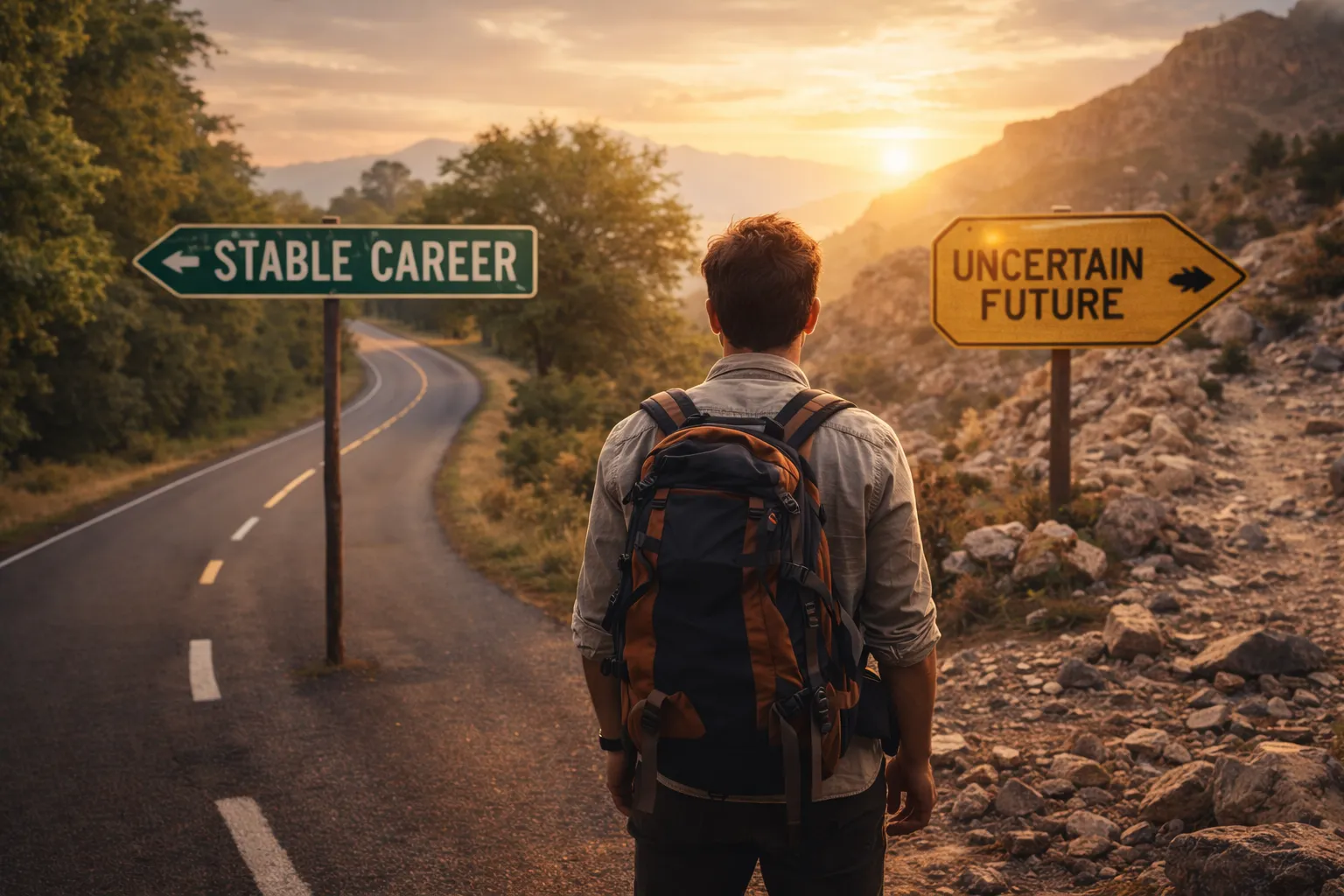
During my years as a strategic consultant and researcher, a "stable path"—much like a well-paved asphalt road—always lay before me. There was no immediate reason to veer off that path. I had become intimately familiar with the work; no matter what problem was presented, a clear map of the process and the expected outcome would instantly form in my mind.
Explaining my profession and my achievements to others was effortless. A single business card was all it took—I never had to explain my social standing or my expertise in detail. On that path, I was safe, I was competent, and I was on a fast track to success by every social standard. Yet, paradoxically, on that perfect map, I was beginning to lose my way.
The Crisis of Momentum over Choice
The real issue was that this comfort no longer felt like a "choice" driven by my own will. Waking up, commuting, and writing reports felt less like decisions I wanted to make and more like surrendering to a momentum that simply kept me moving. As familiarity deepened, the questions I asked myself grew noticeably sparse.
"Why am I doing this right now?"
This fundamental question became buried under daily routines and comfortable rewards. Before I knew it, I was becoming optimized for a state of "acting without thinking." The results were consistent, but the "I" within those results was fading. It wasn't the pinnacle of a career; it was a signal of stagnation, where personal growth had ground to a halt.
Not Courage, but a Shift in What Was "Unbearable"
When people see me leaving behind a stable job and a built career to enter the world of solo development, they often say, "You made a very courageous choice." However, I find it hard to readily agree with that assessment. For me, this wasn't a reckless challenge born of grand bravery, but a deeply personal choice based on my own logic for survival.
On the surface, the stable path looked infinitely comfortable, but inside, a different kind of burden and pain was building up. Repetitive analytical frameworks, predictable outcomes, and disappearing questions. For me, enduring that familiar state of stagnation day after day was far more painful and burdensome than jumping into an uncertain future and facing it head-on. In other words, I didn't summon courage; I simply chose the path I could actually sustain over the one that was becoming increasingly unbearable.
Uncertainty Is a Condition to Accept, Not Eliminate
When I first considered independence, I wanted to establish "certainty" above all else. Coming from a strategic background, I thought that if I prepared more thoroughly, gathered more market data, and managed every anticipated risk in a spreadsheet, the uncertainty would vanish. But after stepping onto the field as a solo founder, I realized a cold truth.
Uncertainty is not an enemy to be conquered or eliminated; it is the admission fee and the default setting for walking this path. The more I tried to perfectly control every risk, the more my execution slowed down and the larger my fears grew. The moment I accepted uncertainty as a condition—setting the principle to "just go, even without knowing"—was the moment the questions I truly wanted to ask began to come alive again.
Choice Always Comes Before Results
We often wait for a successful outcome before justifying that "my choice was right." In reality, the order is completely reversed. You make the choice first, and then you endure the painful process of proving that choice wasn't wrong to create the result.
Results don't prove the choice; the choice drives the results. This is why making a choice is always lonely and difficult. It’s not a multiple-choice question where you can verify the answer beforehand. But that is also why a choice is powerful. Because it is a choice I made myself, I gain the "agency" to absorb even the bitter failures and numerous trials as my own assets without blaming others.
My New Standard for Decisions: No Regrets
My decision-making criteria has shifted from "Is this choice objectively correct?" to "Can I fully accept and take responsibility for this choice?"
The decision I made might be wrong. The service I poured my heart into might be ignored by the market, or I might face financial difficulties. But as long as it wasn't a decision pushed by the gaze of others or social momentum—if it’s a choice I contemplated and finalized myself—I can endure the outcome. I have chosen 'my own direction' over stability, and 'sustainability of life' over certainty.
Toward a Path of Fewer Regrets, Rather Than a Flashier One
I don't believe this path guarantees more success or higher fame than my previous career. I moved simply because it was the direction where the future me, looking back 10 or 20 years from now, would have fewer regrets. I’d rather say, "At least I tried," than wonder about the road not taken.
Breaking out of the hard shell of stability to focus on my internal questions wasn't an act of bravery for others to envy. It was a sincere and desperate "choice" to rescue myself from a stagnated life. And now, within the uncertain noise and silence this choice has brought, I feel more alive than ever.
* Support via Ko-fi is available through the menu, profile, or the link below.